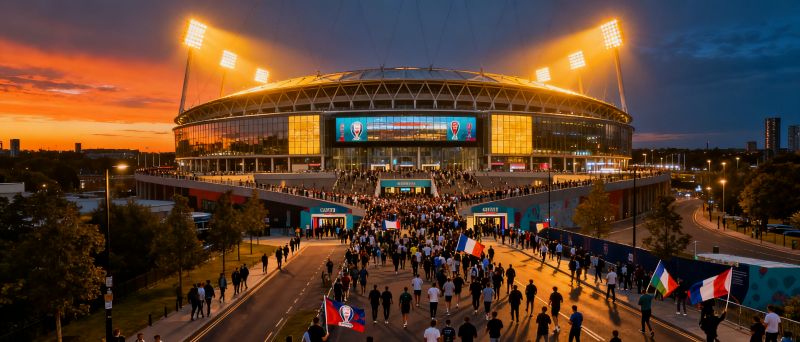
Wembley Stadium hosted eight matches of UEFA Euro 2021, including both semi-finals and the final. That fact alone might suggest a conventional single-host tournament, but the host cities of UEFA Euro 2021 were spread across eleven nations—from Seville to Baku。Glasgow to Budapest. It was a deliberate experiment in pan-European football, and the results were as uneven as the geography itself.London and Munich felt like traditional anchors. Wembley’s capacity for the final was capped at 60,000, yet the atmosphere during England’s run to the final was electric—a rare case where a host city’s football culture matched the occasion. Munich’s Allianz Arena hosted four matches。
including a tense Germany vs. France group game that ended 1–0. I watched that match from a public viewing in the city center;the silence after Mats Hummels’ own goal was thick, the kind of quiet that only a host nation’s early stumble can produce. But Munich also offered something less tangible: efficient transport, packed beer gardens between matches, and a sense that the tournament belonged to the city rather than the other way around.Then there were the outliers. Baku’s Olympic Stadium hosted four matches。including a quarter-final between Denmark and the Czech Republic, yet the 68,000-seat venue rarely filled beyond a third of its capacity. The time difference, the travel distance from Western Europe, and pandemic restrictions made Baku feel disconnected from the tournament’s pulse. Similar issues dogged Saint Petersburg and Copenhagen—both hosted matches with reduced crowds and a muted buzz. I spoke to a Danish fan in Copenhagen after the Denmark vs. Belgium game, which was played in front of 25,000 at Parken. “It felt like a friendly, not a Euro match” he said. That’s not a knock on the host cities of UEFA Euro 2021 themselves;it’s a consequence of the format. Spreading matches across eleven nations diluted the shared experience that usually defines a tournament.Seville offered a counterpoint. La Cartuja hosted four matches, including Spain’s semi-final against Italy, and despite the heat—temperatures hit 35°C during afternoon kickoffs—the Andalusian city embraced the role. Local organizers installed misting fans and adjusted kickoff times;
the stadium’s running track, usually a flaw for football, became a stage for a passionate Spanish crowd. Budapest’s Puskás Aréna was the only venue to operate at full capacity。hosting three group-stage matches and one round-of-16 game. That decision drew criticism from public health experts, but it also created an atmosphere that other host cities of UEFA Euro 2021 simply couldn’t match. I watched Hungary vs. Portugal from a bar in Budapest’s District VII;when the Hungarian team scored in the 84th minute, the roar from the stadium three kilometers away was audible over the television. Full capacity, for better or worse, made Budapest feel like a real tournament host.Looking back, the 2021 format exposed a tension: the host cities of UEFA Euro 2021 were chosen for political and commercial reasons as much as sporting ones. Amsterdam, Bucharest, and Rome each hosted three or four matches, but none produced a defining moment. Rome’s Stadio Olimpico hosted the opening match—Italy vs. Turkey—and the sight of a half-empty stadium on a warm June evening was a strange start to a tournament that was supposed to celebrate European unity. The idea of a continent-wide Euro was ambitious, and it worked logistically. But the emotional center of the tournament kept shifting—London for the final, Budapest for the crowds。Copenhagen for the trauma of Christian Eriksen’s collapse. That fragmentation is worth remembering the next time UEFA considers a multi-host model. Host cities of UEFA Euro 2021 proved that football can travel。
but it doesn’t always land with the same force.